USA vs. GOD
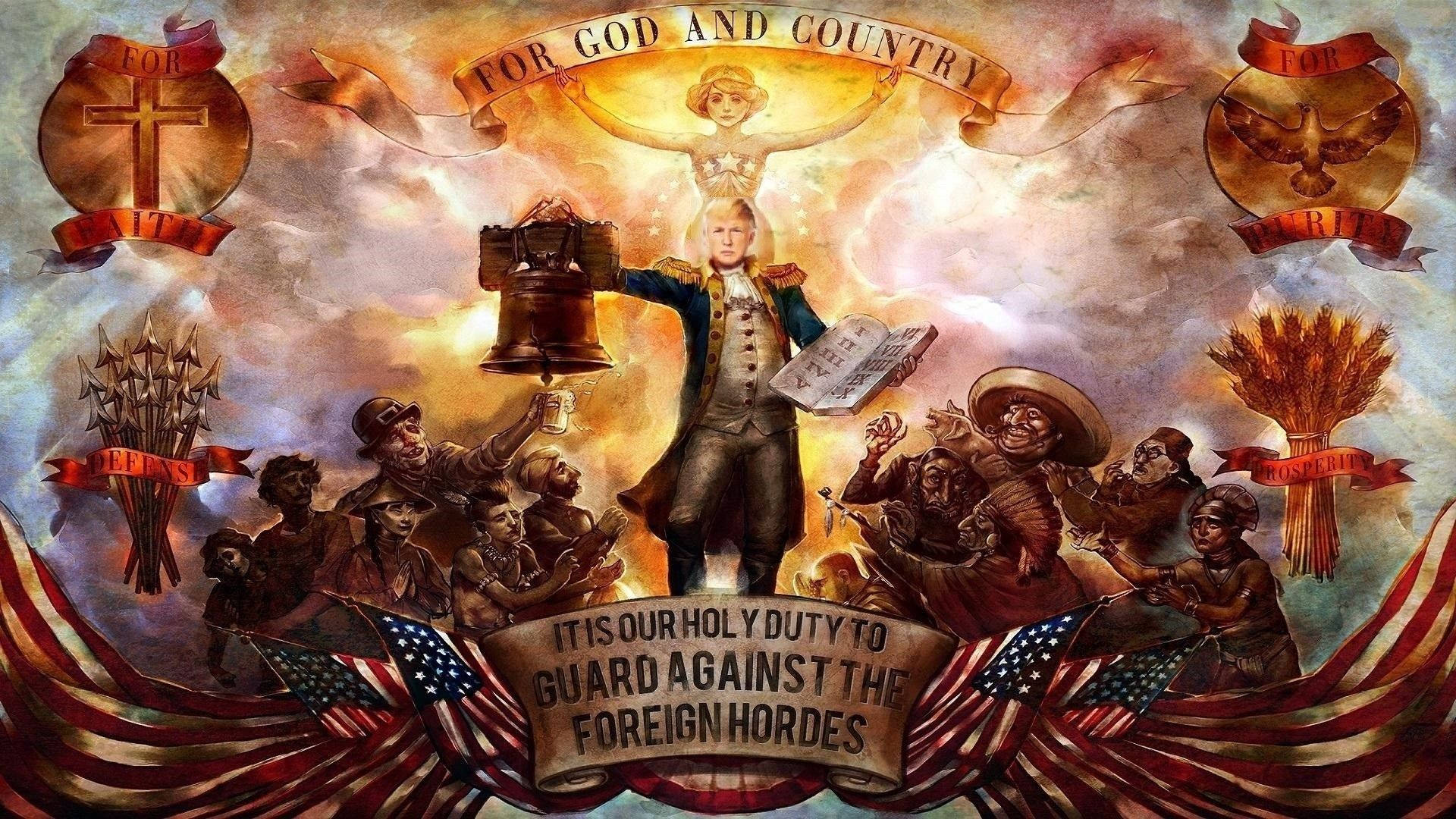
Before embarking on a discussion of a thorny and potentially divisive subject, it is only fair—and, I would say, intellectually honest—to make my bias explicit from the outset, rather than letting it emerge implicitly along the way. When it comes to religion, my more “polite,” measured formulation is this: I regard it as the right answer given to the wrong question—a construction that may possess its own internal coherence, yet ultimately rests upon premises that I do not share.
If, however, you are asking for a less restrained, more unvarnished assessment—one that dispenses with diplomatic caution—then the tone necessarily shifts. In that register, I would describe religion as an accumulation, a layered mass, of archaic nonsense: ideas and narratives inherited from a distant past, preserved more by habit and tradition than by any enduring claim to truth.
On the other hand, having been born in a country shaped by a distinctly Catholic aesthetic, before turning my back on it I felt the need to understand precisely what it was that I intended to abandon—and why. I went through the whole of catechism, diligently and without shortcuts, under the guidance of someone considered competent—otherwise he would never have been assigned to a “leftist” area of Italy—and I applied myself to studying “the theory” with a certain seriousness and care.
For this reason, when I find myself debating with “Catholics”—or rather, with those who are dressed as Catholics—I often feel compelled to correct them. The political agenda they carry, which is Catholic only in an aesthetic sense, frequently leads them to make statements that are "doctrinally" incorrect; that is, positions which are not, in fact, the official stance of the Catholic Church, and which are often regarded within it as errors, sometimes even serious ones.
So, let us begin with the image I have of American Christianity. And the image I hold is that of a form of Christianity that is profoundly, almost insistently, Jewish in character. So markedly so that the figure of Christ takes on—much as often happens within Judaism itself—distinctly messianic qualities, qualities which are then, in turn, frequently “inherited” or echoed by various preachers. Rabbinic messianism, after all, is a typical and recurring feature of Judaism far more than it is of Catholicism.
Why do I hold this image? We can summarise the history of that religion in fairly concise terms. In the beginning there were the five books of the Pentateuch (sometimes accompanied by the Book of Enoch, though that changes little in substance), and—apart from a religious minority known as the Samaritans, who had, and still have, six books—the Jewish people were governed by this divine law, the Mosaic Law.
Then this Jesus Christ appears, and one thing is clear from the outset: he arrives to reform—if not outright abolish—both the Jewish priestly class of the time and the Mosaic Law itself. It is, therefore, a moment of rupture. Certainly, what this man preaches stands at a considerable distance from the Mosaic Law, which is structured around the dichotomy of obedience versus disobedience typical of the Old Testament, and instead introduces the dichotomy of good versus evil, along with other elements that would, over time, become part of Christianity.
Thus, Christ represents a figure of rupture, a break between the old religious ruling class—the Rabbis—and a new way of understanding religion and the word of God, including His will. The vengeful, jealous, wrathful God recedes, and in His place emerges a God who, according to Christians, is primarily a loving one.
I will not dwell on listing the historical reasons that led Christians to retain the Torah as part of their religion. They were not, strictly speaking, religious reasons; rather, they amounted to a form of syncretism, deliberately adopted in order to eliminate a competing faith that was spreading throughout ancient Rome: Judaism.
Yet by incorporating the Old Testament into its overall framework, the Catholic Church found itself, for nearly two thousand years, both benefiting from it and being constrained by it. The Old Testament could be invoked to justify the brutal methods of the Romans, which had been absorbed into the Church; but at the same time, in order to keep Judaism at bay, the Church was compelled to insist—again and again—that in any conflict between the Gospel and the Old Testament, since Christ is central, Christ must always prevail. Whereas, if one were to lean more toward the Jewish side than the Christian one, then it would be the Old Testament that prevails—but at the cost of placing oneself perilously close to excommunication.
In short, American Christianity—or at least a significant portion of it—has veered toward Judaism. The “MAGA Christians” are, in effect, Jews (with all the attraction this entails toward Israel) of a strongly messianic bent, who do indeed accept a Messiah, Christ, but interpret the Messiah in a distinctly Jewish way: as an emissary of the God of Hosts, one who has not come to challenge or strip authority from the rabbis, but rather to complete the work and bring about a kind of Greater Israel.
These Americans are, quite simply, messianic Jews who do accept Jesus, but not in the Christian sense; rather, in the sense the term carries within Judaism—that is, as an emissary of the God of Hosts of the Old Testament.
They tend to belong to circles that do not frequent churches very much, except when it serves their interests, and therefore have not personally benefited from any sustained guidance that might have explained to them the fundamentals of catechism.
Under these conditions, sooner or later a schism within this Judaized strand of Christianity was bound to emerge. It was only a matter of time, and I would argue that Trump has likely accelerated a process that, in any case, would eventually have led to such a rupture. This notion of Christ as a Jewish-style messiah, carrying in one hand a rifle and in the other a credit card, was never something that could endure indefinitely.
For all that the Catholic Church has, for millennia, incorporated the Old Testament within its structure, the necessity of presenting Christ as a figure of rupture—one who exposes and denounces hypocritical rabbis and pseudo-religious political operators—would, sooner or later, have generated an internal conflict.
And here we are. Now.
How far might such a schism go? Historically, schisms tended to culminate in a council, where an initial attempt was made to preserve a degree of theological coexistence through a certain flexibility, until the moment of the “tear”—that is, the formal rupture. Within that older framework, a distinction was clearly drawn: a schism was not the same as excommunication. Thus, Eastern Orthodox Christians were considered schismatics but not heretics, whereas Lutherans were regarded as fully heretical—this was not a schism, but heresy.
In the contemporary perspective of the Catholic Church, however, this language has been significantly softened and, in part, reframed. While the conceptual distinction between schism and heresy still exists, it is no longer applied in the same direct or polemical way to living communities. The Orthodox are now described as “sister Churches,” possessing valid sacraments and apostolic succession, while Protestants—including Lutherans—are generally referred to as “separated brethren.” The charge of heresy, in this modern context, is understood as pertaining to historical doctrinal divergences rather than to the personal condition of believers who are born into those traditions.
A similar dual perspective applies to Judaism. Historically, the relationship was marked by a strong polemical stance: Judaism was seen as a religion that had failed to recognise Christ, often portrayed as spiritually blind or obstinately attached to a superseded covenant. This theological position, intertwined with social and political dynamics, contributed over centuries to a climate of suspicion, marginalisation, and at times open hostility.
In the modern position of the Catholic Church, however, this framework has been profoundly revised. Judaism is no longer described as a rejected or obsolete religion, but as the root from which Christianity itself has sprung—a living tradition bound to Christianity by a shared heritage. The idea of collective guilt has been explicitly rejected, and the Jewish people are no longer depicted as abandoned by God. Instead, the emphasis is placed on a relationship of continuity, dialogue, and mutual respect, even where theological differences remain irreducible.
It is clear that it is no simple matter to predict which approach will ultimately be adopted. If these Judaical American Christians, who have remained attached to the Old Testament, were to be regarded as messianic Jews, they would fall under the broader category of “Jews,” and could, in principle, be pushed outside the bounds of the Catholic Church. Such a move would carry both advantages and drawbacks. On the one hand, it would preserve what might be called the “healthy” core of American Catholicism, thereby containing the damage. On the other, it would place the Church in open conflict with a substantial portion of the American population—and with its political sphere as well.
The Church, therefore, is faced with a choice: whether to treat MAGA Catholics as messianic Jews in all but name, or as Christians whose theology has become excessively tilted toward the Old Testament.
Personally, if I had to place a bet, I would first observe that the American Church has rallied around the Pope with remarkable unanimity; and, consequently, if the Pope were to attempt any form of “negotiation” with MAGA Catholics, he would have to do so in a way that does not humiliate those Catholics who have remained loyal to him.
I do not believe, however, that Trump will be willing to back down, and so I see a rather bleak outcome ahead: if the Trump-aligned factions continue to escalate, excommunication may become almost inevitable.
But let it be clear: the confrontation has now begun, and there is no turning back.
With all that this inevitably entails.