Oh, C'mon, Mastodon!
Today, purely by chance, I noticed that mastodon.social has blocked me. It’s quite interesting, because after looking around online I found, essentially, the supposed “reasons” for this action, and honestly I’ve been laughing about it all morning, precisely because the whole thing borders on the grotesque.
Basically, my small instance — which is, in fact, a single-user instance, not some giant platform — has been blocked on the grounds that, according to them, it is “unmoderated” and practices total free speech, allegedly allowing, again according to them, Nazis and the like to write freely. And this is interesting, because for years and years I have stated clearly, not in a hidden way but in black and white, even in my instance’s ToS, that as far as moderation is concerned I fully adhere to German law.
If something is prohibited in Germany, then I remove it from my instance, without discussion and without personal interpretation. If something is not prohibited, then as far as I am concerned it is legal, and therefore you are allowed to do it. This is not an abstract principle or a vague declaration: it is an operational rule that I apply every day, and it is also explicitly documented in the terms of service, therefore verifiable by anyone who actually wants to check instead of inventing narratives.
Evidently, for people like Eugen Rochko, German law itself is not enough. In the sense that he wants it to be more — I assume — repressive and censorious, or else he wants to add an additional layer of ideological moderation that has nothing to do with the law. Otherwise, he would not accuse my instance of being a “free speech” instance, or, as they say in woke jargon, “freeze peach,” which is already in itself a caricatural way of dismissing the issue without addressing it on its merits.
After all, “labels are the opposite of understanding”
So then you might say: perhaps you claim to follow German law, but in reality you don’t. Aha. So you are saying that I host content that is illegal in Germany? Try to show it to me, if you can. Because here we are talking about the law, not something you can “say but not do”: if you don't “do” the law, the police show up — not an indignant comment on the internet.
Moreover, I had not received any reports, and therefore I would not be able to say, precisely, what I am accused of or what, according to them, would be the illegal content in Germany present on my instance. Which is already curious in itself: a decision is made, a sanction is applied — because that is what it is — but without there having been even a minimal step of reporting that is verifiable from the other side.
But I noticed something, and here the matter becomes more interesting. It happened on April 3rd. And April 3rd is exactly the day on which I started talking about Aktor, that is, this project here: Aktor.
And I already know perfectly well what will be said: “well, there are many instances, but they only blocked yours.” Absolutely true. No one denies that. The point, however, is not that. The point is to understand what is “special” about Aktor compared to the rest of the landscape.
And here the answer is (it seems to me) simple: at a certain point I wrote something very precise. Not a vague opinion, not barroom chatter, but something technical, structural, which concerns the very way the system itself works.
Namely this:
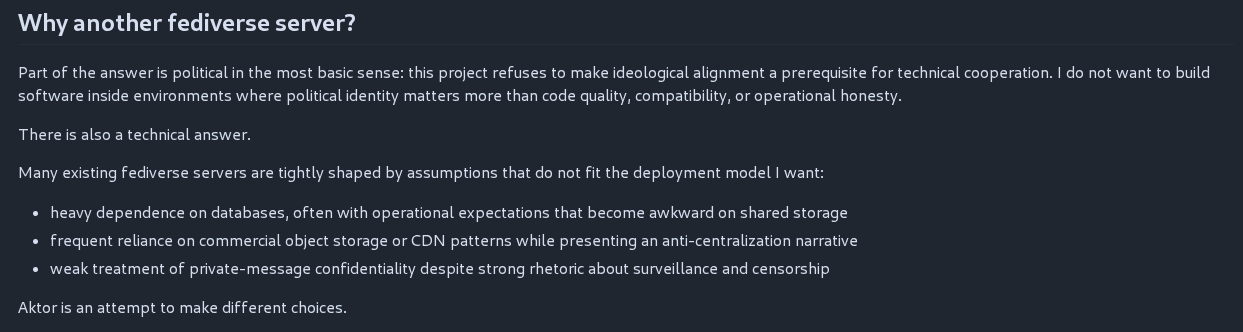
In practice, I point out two things — which then become three, because once you start looking under the hood, the narrative begins to creak more or less everywhere.
- Despite the fact that they keep going on about the “fight against GAFAM” — that is, Google, Amazon, Facebook, Apple, Microsoft — and against the evil multinationals that spy on you and collect your data, when it comes to storage, across the entire fediverse landscape, the only one effectively allowed is Amazon S3. This is not a neutral choice: it is a structural dependency. When you access an image, for instance, stored on S3, what happens is very simple: Amazon knows everything about you. Where you come from, your IP, any cookies, which fediverse user you are, and — if it analyzes the content — it can even form an idea of your tastes. So much for “independence from big tech.”
- Despite the fact that they keep invoking privacy this way and that, in practice messages between users have been stored in plaintext in the database for years. And even in the — theoretical — case in which they were stored encrypted, the problem would not change: if the US government accesses the cloud instance on which Mastodon runs, it has both the database and the keys. So the “solution” being proposed solves nothing; it is merely cosmetic reassurance.
- Despite the fact that they keep invoking the fight against surveillance, the transport of private messages follows the same logic as everything else: it uses a domain name, that is DNS, that is root DNS, which are in fact under the control or strong influence of the US government. So here as well, the infrastructure is anything but neutral.
Clearly, I have made different choices. I will use IPFS as CDN and storage, I will use I2P as transport without DNS, and Pretty Good Privacy (PGP) as public/private key cryptography. This is not an ideological stance: it is a technical consequence of what I have just described.
But the problem is not the technical choice. The problem is the message. The problem is that behind all the “fediverse” and its rhetoric of “we are the good ones, they are the bad ones,” there is in reality a system of gatekeeping that instills in people a false sense of security and freedom, and convinces them that they are fighting a system with which, in practice, they are willingly collaborating, without even realizing it. Or perhaps they do.
So I now want to introduce the word “gatekeeping.” What is a gatekeeper? It is someone who, as Beppe Grillo once did, convinces you that you are carrying out a terrible revolution, that you are opposing the regime, while in reality you are preventing change from happening. Why? Because this supposed “rebellion” is already channeled, managed, rendered harmless — often by the very same people or the same circles that then make up the “system” you believe you are fighting against.
One example is the occupied social centers (in Italy, these are buildings taken over and run by activist groups, often associated with left-wing or anarchist movements), which in the prevailing narrative are perceived as antagonistic spaces, whereas in practice they are perfectly compatible with the overall equilibrium — to the point of appearing, rather than a problem, as a pressure-release valve. Another example is the Movimento 5 Stelle, which begins as a radical rupture and quickly ends up integrating into the political system it claimed to fight. And then, to remain within the technological theme, there is also Amazon: demonized in words, but in fact central and indispensable in the infrastructures used by those who proclaim themselves “alternative.”
As for me, being Gen X, I largely do not care about these dynamics. I have no revolutionary vocation. My problem is not to “change the system” or bring it down: the system is made of people, and in the overwhelming majority of cases they are what they are. Revolutions, in my experience, are above all a way for someone to build a following and recruit a personal army in order to reach power.
So no: I do not claim to make revolutions, nor to change the world. I confine myself to stating things that are far more mundane and verifiable. That IPFS does not store its data on Amazon S3 storage. That I2P does not use DNS roots under US control. That public/private key cryptography, such as that of Pretty Good Privacy, makes it much more difficult to read messages. And that, if the data reside on filesystems and not in a centralized database, encryption becomes simpler, more transparent, and harder to circumvent.
Nothing else. Not ideology, not narrative, not “struggle.” These are technical facts.
The opposite of gatekeeping.
Am I worried? No. I have already had experience with other wannabe Zuckerbergs, including in Italy, and I have noticed one very simple thing: when you ban their instances, in practice almost nothing changes. The famous “huge number of users” that is supposed to make them “whales” is often inflated by rather ridiculous metrics, based on extremely elastic definitions of what an “active user” is, so to speak, and designed more for show than to describe reality.
Moreover, in my personal experience — both as someone who frequently switches instance software, in the hope of finding one that actually does what it promises, and as someone who has changed domains multiple times in a self-hosting setup — I have seen how the fediverse, precisely because it is a distributed network, is in fact self-healing. It is not a centralized system that collapses when a node goes down: it reconfigures itself, adapts, finds alternative paths.
Nothing changes. So much so that I realized that mastodon.social had blocked me for an almost comical reason: one user — a single user — could no longer see my posts. ONE. You can well understand what kind of “devastating impact” something like that can have.
And once this post is published, it is likely that those few users who might be affected by the censorship will simply move to other instances, perhaps smaller or less visible ones. Which, once again, demonstrates how fluid the system is and how difficult it is, in practice, to truly isolate someone without side effects.
It does not affect me much, honestly. And so no, I am not worried about it.
What you should be dealing with — or rather, what you should be concerned about — is something else. That this “alternative” system is in reality a gatekeeper. That is, a fiction: an environment in which people spend their time telling themselves how free they are, how protected they are, how they are no longer being spied on, while in concrete reality the technical measures required to actually achieve that freedom and that privacy are simply not there.
There is talk of independence, but centralized infrastructure is used. There is talk of privacy, but the data remain accessible. There is talk of autonomy, but everything depends on mechanisms that reside elsewhere. It is a coherent narrative, certainly, but it remains a narrative. When you go and look at what really happens under the hood, the gap between what is said and what actually exists becomes quite evident.
And the point is not even that these solutions are difficult or impossible. They are not. Precise technical alternatives exist, concrete tools exist, different architectures exist. The problem is that they are not adopted, and when someone tries to use them or even just to talk about them seriously, the reaction is not technical curiosity, but closure.
And if you try to put them in place…
Will I finish Aktor? Certainly. Will I implement IPFS, I2P and PGP? Certainly. Will I put it online? Today or in a few days at most — this is not a vague promise, it is simply the technical time I need to wrap up the final details.
Will it federate? Yes, unless it gets blocked, which at this point is a possibility to take into account without pretending otherwise.
Will I take money from the EU for a system that does NOT meet the POLITICAL reasons for which it appears to have been created?
No, thank you.