Towards a sci-fi compass.
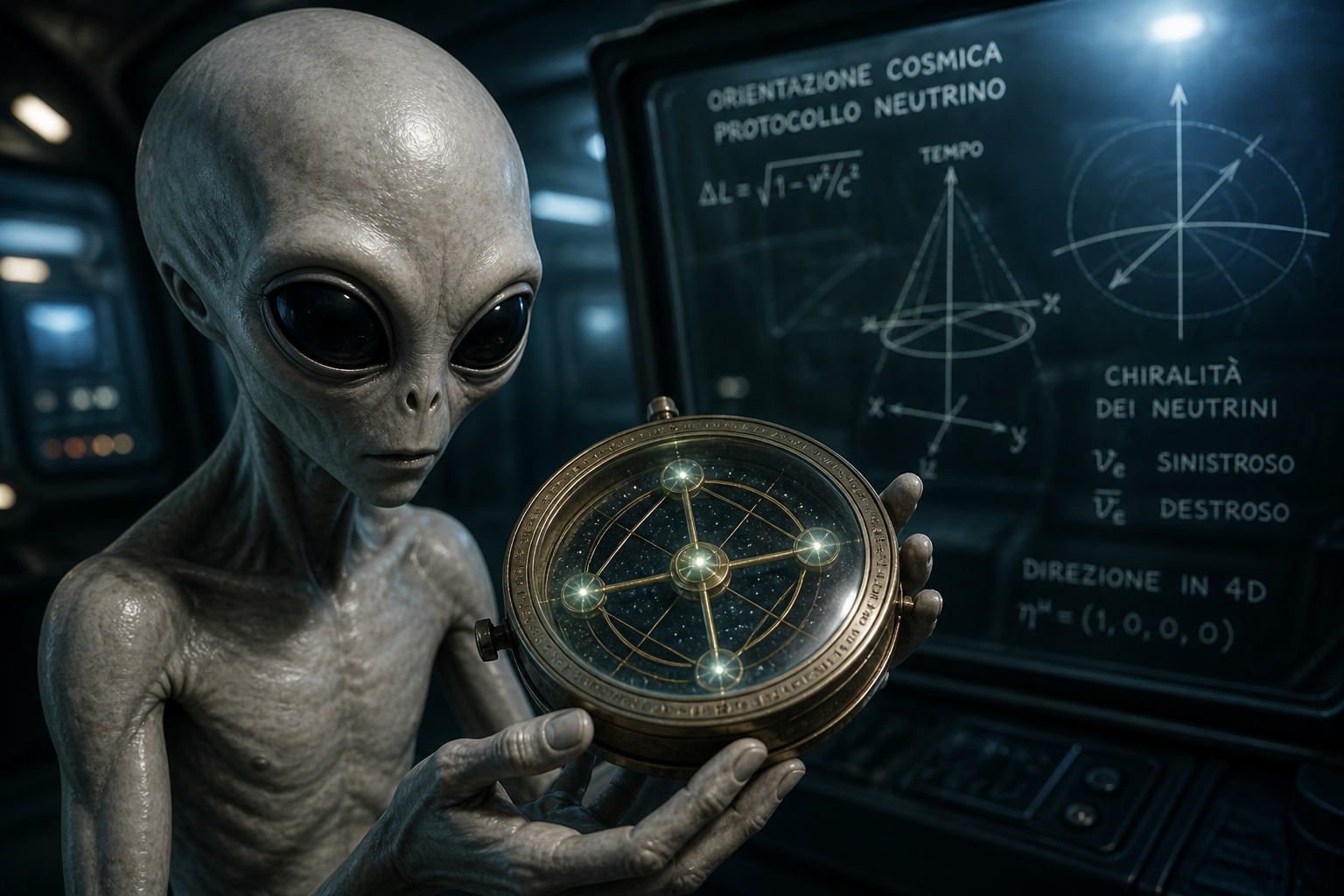
Writing science fiction often means confronting questions that, when pursued far enough, end up looking remarkably like problems in theoretical physics. And sometimes it even forces one to search for solutions credible enough not to make the entire narrative edifice collapse the moment it meets a reader with a passing familiarity with relativity.
Let us suppose, then, that we are in deep space.
We already know that in a vacuum there is not, at least so far as current knowledge allows, any absolute “cosmological sextant”: that is, no universal coordinate system intrinsic to the fundamental laws themselves, capable of telling us objectively and definitively where we are. Modern physics allows us to describe position and motion in relation to structures, fields, masses, background radiation, cosmological expansion, but it does not spontaneously hand us a metaphysical Cartesian grid engraved into the universe itself.
In other words: we can build maps, but a map is not automatically an absolute direction.
And this is where the problem becomes more interesting.
Let us imagine, then, encountering an alien civilization in some remote region of the cosmos. Let us even suppose that it possesses exactly the same map of the observable universe that we do, with galaxies, clusters, quasars, and cosmic background radiation perfectly cataloged. There would still remain an astonishingly subtle question: how does one determine, using only absolute properties of physics, which direction on that map is “north” and which is “south”?
Because a map may tell you where objects are located, but not necessarily how to orient it in a universally shared way.
Put more rigorously: the problem is not merely topographical, but one of global orientation.
I am not, therefore, asking whether it is possible to construct a cosmic sextant, something capable of providing absolute position.
I am asking whether it is possible to construct at least a cosmic compass.
Something that does not tell us “where we are,” but at least “which way we are facing.”
A simple privileged direction. A universal “North.” A structure of orientation that two civilizations, no matter where they are situated in spacetime, could independently derive by using the same fundamental laws.
And here the question ceases to be merely narrative, and begins instead to brush against differential geometry, relativity, and fundamental symmetries.
Because if, in classical three-dimensional space, this problem appears insoluble without arbitrary conventions, then perhaps the path forward consists, paradoxically, in doing precisely what relativity has been forcing us to do for more than a century:
ascend by one dimension.
To stop thinking in terms of three isolated spatial dimensions, and instead reason in terms of four-dimensional spacetime, a Lorentzian manifold in which time and space are no longer separate entities, but components of a single geometric structure.
And at that point, the question changes radically.
If we cannot obtain an absolute position, can we at least extract an absolute orientation?
If the cosmic sextant remains forbidden, might the cosmic compass instead be possible?
In fact—at least on the mathematical level, and perhaps precisely thanks to certain asymmetries already known within fundamental physics—the answer may be far less absurd than it first appears.
For a very long time, physics treated the universe as though it were fundamentally symmetrical. The intuitive idea was simple: if one could observe a phenomenon through a perfect mirror, the laws of nature should function in exactly the same way. Right and left, in essence, seemed to be purely conventional differences, almost a matter of perspective.
Then came one of the most fascinating fractures in all of modern physics.
In 1957, the experiment conducted by Chien-Shiung Wu—a Chinese physicist whose work proved decisive in the experimental demonstration of parity violation in weak interactions—showed that this symmetry, at least in certain fundamental processes, was not sacred at all. The universe, absurd though it may seem, possesses a preference.
In highly simplified terms: the neutrinos observed in weak interactions are associated with left-handed chirality, while antineutrinos appear right-handed. In other words, when the weak force enters the picture, nature genuinely distinguishes between right and left.
This is no longer a human convention.
It is physics.
This means that, at least in theoretical terms, if I were to encounter an alien civilization and possessed a sample of cobalt-60, or any system capable of displaying observable beta decay, I could use that process to communicate something beyond language itself: a physically shareable definition of “left” and “right.”
Not “my left” or “your right” as mere cultural labels, but a distinction rooted in the fundamental laws themselves.
For the first time, two completely separate observers, with no shared history, no shared biology, and no shared geometry, could agree upon a fundamental asymmetry.
And that is already extraordinary.
But it is still not enough.
Because here the more subtle problem emerges.
Knowing that we can both distinguish “right” from “left” does not yet mean we know how to orient our bodies, or our maps, within the same three-dimensional space.
The alien and I might agree perfectly on which hand is the right one in absolute physical terms, and still remain rotated by 37, 62, or 85 degrees relative to one another.
And then what?
Chirality, in three dimensions, resolves a mirror ambiguity, but it does not automatically resolve a directional ambiguity.
Put more rigorously: it eliminates parity indeterminacy, but it still does not select a global spatial axis.
In a classical 3D space, then, the problem remains incomplete.
We know how to distinguish the hand. But we do not yet know whether it is “our” right or “their” right.
We still do not know where to point the compass.
And this is precisely where the question becomes interesting, because relativity forces us to stop thinking in purely three-dimensional terms.
If we remain in 3D, chirality gives us a grammar of orientation, but not a geography.
It allows us to agree on the meaning of “right” and “left,” but not on their value.
Not yet on which direction in the universe ought to be considered “North.”
But if we stop thinking like creatures trapped within three-dimensional space, and begin instead to reason within four-dimensional spacetime—where time itself becomes a structural coordinate, a global causal orientation—then the matter may change radically.
In 3D, chirality is only half the problem.
In 4D, however, the mathematics of the matter changes profoundly.
Now we make the truly interesting leap, the one that takes the question beyond simple three-dimensional space and transforms it into a problem in the geometry of spacetime.
Let us take, for narrative simplicity, a closed and curved four-dimensional relativistic universe—a kind of “spherical universe,” or at least a globally time-oriented Lorentzian manifold, of the sort that certain Hawking-like cosmological simplifications have made popular in the imagination. It does not matter here whether the model is literally correct in every cosmological detail: what we need is merely the idea of a curved 4D spacetime endowed with a coherent temporal orientation.
In other words: time always possesses the same causal direction.
First the past. Then the future.
By itself, this information is still not enough to construct a cosmic compass. A global arrow of time is an orientation, not a spatial direction.
But now we introduce the second ingredient.
Let us suppose that we emit three neutrinos along three mutually orthogonal directions within local three-dimensional space, thereby constructing a generating subspace. In a purely 3D space, this produces nothing particularly special: we can construct infinitely many equivalent systems, rotate them at will, and none of them possesses any intrinsic privileged direction.
But in 4D spacetime, the situation changes.
Because that three-dimensional subspace no longer exists in isolation: it becomes a 3D hypersurface embedded within a four-dimensional structure already causally oriented by time.
And this is where chirality enters the picture.
Through parity violation in weak interactions, neutrinos do not merely trace three arbitrary axes: they introduce a physically non-specular orientation. In intuitive terms, they are not simply constructing a surface; they are constructing a surface with handedness.
At that point, the combination of:
- a locally generated three-dimensional hypersurface,
- a global arrow of time
- a non-arbitrary chiral orientation,
produces something new.
Not an absolute coordinate system.
Not a cosmic sextant.
But a direction. A compass.
An oriented normal. A “needle.” A one-dimensional axis derived from the combination of global causality and fundamental asymmetry.
In more elegant terms: a cosmological compass.
My hypothetical alien friend and I, even if we were located in completely different regions of the universe, might not be capable of assigning one another absolute coordinates in the manner of some metaphysical GPS. We would not necessarily know “where” we are in any universal sense.
But we might, at least in principle, be able to agree on something more subtle:
which of us lies farther “east” relative to the other.
Naturally, “east” is only a linguistic metaphor, a three-dimensional way of describing an emergent direction defined within a curved and oriented 4D spacetime. We could call it cosmic North, a chiral axis, an oriented causal vector, or any other more technical name.
The point is not the name.
The point is that, given two assumptions:
that time maintains a coherent orientation throughout the entire cosmic manifold;
that neutrino chirality remains universally asymmetric;
then it becomes at least conceivable to construct a mathematical procedure capable of extracting a global direction.
Not an absolute position. Not a sextant.
A compass. A simple compass.
And this is where the idea becomes narratively elegant: we have not violated relativity, we have not introduced a Newtonian ether, we have not destroyed Lorentz.
On the contrary, we need Lorentzian structure in order for the 4D framework itself to exist.
We have simply exploited structures already present:
- time-orientation,
- parity violation
- four-dimensional spacetime geometry.
In other words, we are not denying Einstein.
We are asking whether, within Einstein—and within that small, scandalous asymmetry of neutrinos—there may already be hidden something that looks remarkably like a cosmic compass rose.
And apparently, yes: if an experiment of this kind could genuinely be framed in rigorous physical terms, and above all if its mathematical logic proved sufficiently sound to remain internally coherent, then it might offer us something extraordinarily interesting—not an absolute coordinate system, which would still require some form of universal cosmic grid capable of establishing objectively where we are—but something perhaps less ambitious and, precisely for that reason, more plausible: a shareable direction within four-dimensional spacetime.
In other words, an alien civilization and I, provided we existed within the same relativistic universe, subject to the same fundamental laws and capable of replicating the same physical protocol based on global temporal orientation and neutrino chirality, might never be able to construct a “cosmic sextant” capable of telling us with absolute precision where we are relative to one another, but we might instead obtain a compass: that is, a procedure through which we could agree upon a common direction within the 4D manifold.
The distinction is far more important than it may initially appear, because the problem of absolute position inevitably requires a universal origin, a global metric, and a shared coordinate system, whereas the problem of direction is structurally simpler: one does not need to know where the center of the cosmos lies, only how to orient oneself coherently with respect to a replicable physical structure.
If both I and the alien possessed a “map” of the universe—let us say, for example, a cartography constructed through the cosmic microwave background, the anisotropic distribution of galaxies, or any other sufficiently stable observational reference—the true problem would not be the map itself, but its orientation.
A map may, after all, contain precisely the same information for two different observers, and yet remain useless as a common language if there is no physical procedure for determining how to rotate it identically. This is where the protocol would enter the picture: local construction of a generating three-dimensional hyper-surface through neutrinos emitted along orthogonal directions, use of chirality to eliminate mirror ambiguity, use of the arrow of time as a global causal orientation, and from this combination the extraction of a one-dimensional direction—a kind of oriented normal relative to spacetime itself.
At that point, when I received the signal from my alien interlocutor, I would no longer need to ask, “Where are you?” in the Cartesian absolute sense—a question likely devoid of any strong physical meaning—but rather, “In which oriented direction, relative to my causal-chiral structure, are you located?”
I could then compare my own field of orientation with theirs, use the same mathematical compass, and translate the difference between our structures into a shared directional separation. I would not necessarily know how far away they were, because absolute distance would remain a separate problem, but I could know towards which “hyper-direction” of spacetime I ought to point.
In narrative terms, this means that two civilizations might communicate not through absolute coordinates, but through topological orientation: not “I am located in quadrant X, sector Y,” but rather “I am situated at such-and-such relativistic hyper-angle relative to your causal-chiral axis.” Naturally, “hyper-angle” is a literary simplification, but the concept is precisely that of a direction defined within an oriented 4D geometry, rather than a Newtonian distance within a rigid space.
And this is precisely where the idea becomes fascinating from a science-fiction perspective, because it suggests a form of cosmological navigation that does not depend upon an absolute labeling of the universe, but upon the ability to extract, from the very laws of physics themselves, a shared orientation structure. This would not mean discovering an ether, nor dismantling Einstein, but rather exploiting to its fullest extent what Einstein, spacetime geometry, PLUS parity violation already permit: not an absolute map, but a cosmic compass rose.
In such a scenario, a sufficiently advanced civilization might even abandon the classical notion of “address” altogether and replace it with something more sophisticated, akin to navigation by global orientation vectors, where the fundamental question is no longer “Where am I?” but rather “In which direction of oriented spacetime must I move in order to reach you?”
And if this distinction may seem subtle, it in fact separates two radically different concepts: the claim of possessing absolute coordinates of the universe, which remains physically unattainable, and the far more elegant possibility of possessing instead a universal compass, derived not from arbitrary conventions, but from the combination of cosmic causality, relativistic geometry, and that small, scandalous asymmetry of neutrinos which, even now, reminds us that nature is not perfectly indifferent between right and left.
Interesting—and sufficiently credible for a science-fiction novel.
I find it terribly fascinating.