This Is Not a Drill
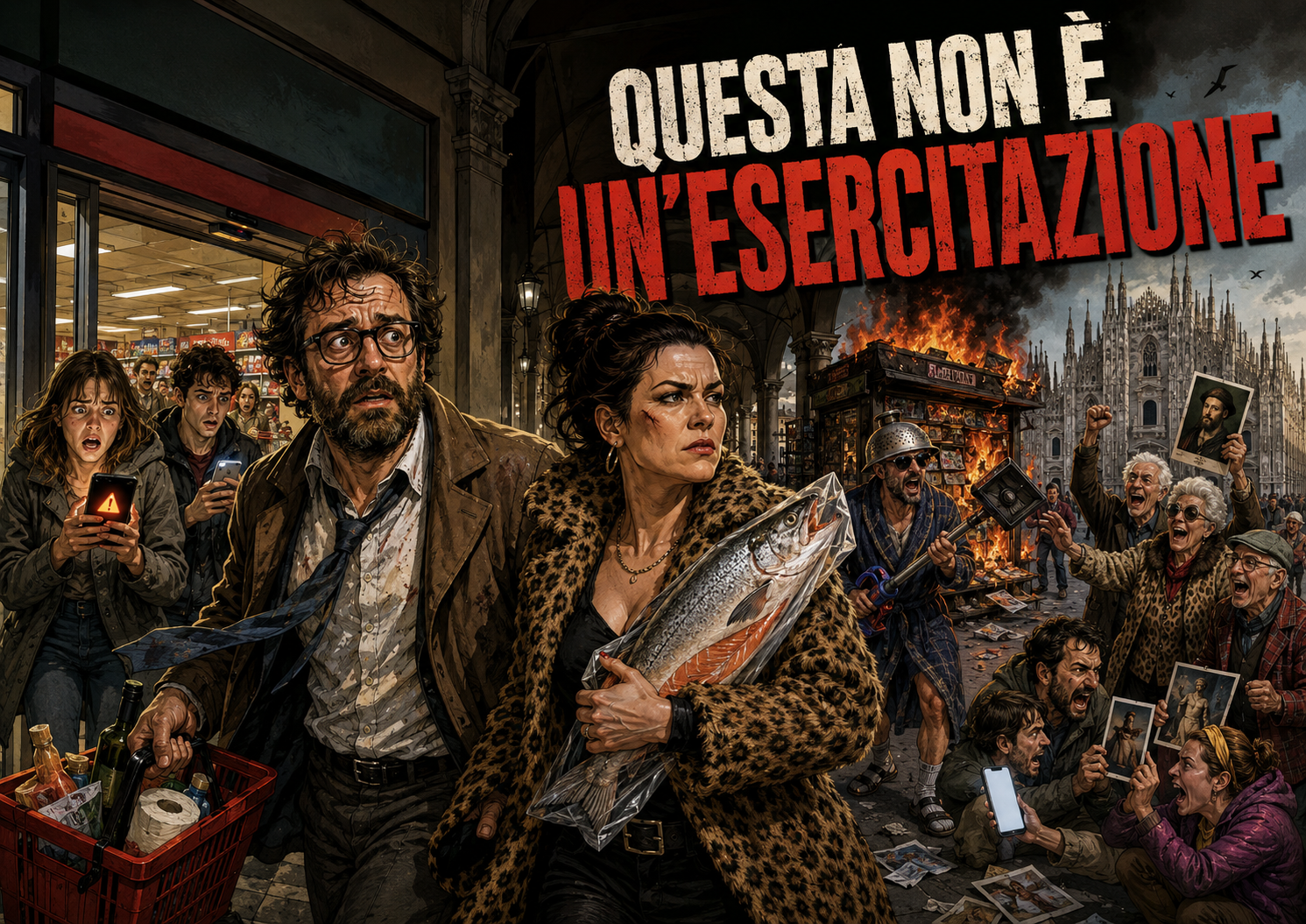
And so, I felt like writing a short story.....
I had been in Milan for only a few hours, having arrived from Germany with that slightly unreal feeling you get when you step off a train or a plane and the world around you is speaking your language again, but not exactly as you remembered it. Milan was doing Milan: traffic, nervous air, people walking as if they were on their way to fire someone, scooters launched like morally superior projectiles, and that Lombard grey which is not a colour, but a diagnosis.
I had come to visit a friend. She lived somewhere around Lodi, but for some reason I cannot remember — and which, knowing us, probably had no importance whatsoever — we had ended up in a supermarket in Milan. In the story I shall call her Wolfie, because every story needs at least one name that sounds as if it came out of a partisan brigade, a biker gang, or a novel the author never had the courage to write all the way through.
Wolfie knew me well. Not in the banal sense of “she knows how I take my coffee”, though she probably knew that too. She knew me in the more dangerous sense: she could predict when I was about to say something horrible in a reasonable tone, when I was about to take offence over some stupidity, when I was about to launch into a tirade about the decline of the West because someone had written “organic” on a packet of industrial biscuits.
We were queuing at the checkout.
In front of us there was the usual supermarket fauna, the kind that proves Darwin was right, but only up to a point. A lady with a trolley full of “free-from” products: sugar-free, lactose-free, gluten-free, joy-free, future-free. A man in his fifties staring at the checkout display as if the ruling of the Court of Cassation were about to come out of it.
A young couple buying hummus, craft beer, and toilet paper: the liturgical triptych of the contemporary urban bourgeoisie. An elderly man with three bottles of red wine and a box of cat kibble, who had clearly understood everything about life and no longer needed explanations.
The cashier scanned the items with the fluid resignation of someone who had seen Western civilisation reduced to barcodes and loyalty points. Every so often the scanner went beep. Beep. Beep. The heartbeat of terminal capitalism.
Then, suddenly, all the mobile phones began to ring.
Not one. Not two. All of them.
A hysterical, metallic, simultaneous chorus, the sort of alarm that does not seem designed to warn you of danger, but to make you wish for it, provided the noise stops. Phones vibrated on counters, inside handbags, in pockets, in people’s hands. Someone jumped. Someone swore. Someone, being an expert Italian, immediately gave someone else a dirty look, because in Italy even the apocalypse must have someone responsible in the immediate vicinity.
At first, nobody really paid attention.
“Ah, it’ll be the drill,” someone said.
And in fact it made sense. Every now and then these public alerts arrive, these civil protection tests, these messages explaining that your phone can scream at you in the event of a catastrophe, as if this were a triumph of modernity and not simply another way of making the end of the world noisier.
Wolfie took her phone, glanced at it, then looked at me.
I did not take mine.
On principle.
Or out of laziness.
Which, over time, I have discovered are two different words often indicating the same philosophical position.
The sound stopped almost at the same moment it had begun, leaving behind a strange void, a silence larger than the supermarket. For a couple of seconds, all you could hear was the hum of the refrigerators, the rolling of a bottle on the conveyor belt, the belated beep of a self-checkout which evidently had not received the news of the imminent end.
Then a voice said:
“Hey!”
Nobody answered.
The voice, louder:
“Hey, this is not a drill!”
At that point, something small but terrible happened.
Everyone stopped.
The cashier stopped scanning the products. The man in his fifties stopped staring at the checkout display. The hummus couple stopped existing as a couple and went back to being two frightened mammals. The elderly man with the wine and the cat food slowly raised his eyes, with the expression of someone who had always suspected it would end this way, but had hoped at least after dinner.
There was one second of terrified silence.
Just one.
But long enough to contain all the stupidity of the century.
Then everyone, at the same time, took out their phone.
It was a reflex gesture, almost military. Handbags snapped open. Pockets were searched. Fluorescent cases. Cracked screens. Trembling thumbs. Faces lit by the cold light of displays. It looked like the religious service of a very poor sect, in which the god was dead but the app still worked.
I looked at Wolfie.
Wolfie looked at the phone.
Then she looked at me.
“It’s true,” she said.
“What?”
She made that face people make when they have to tell you serious news, but they already know you will react in the wrong way.
“It’s not a drill.”
I finally took my phone.
The message was there, dry, bureaucratic, frightening precisely because it was written in that neutral language of public announcements, that language which manages to turn any tragedy into a condominium circular.
NATIONAL ALERT — THIS IS NOT A DRILL.
The text followed.
For a few moments, my brain ran an inventory of the serious possibilities: collapsed dam, toxic cloud, missile attack, nuclear accident, epidemic, invasion of locusts, return of the House of Savoy.
Then I read.
The emergency was this.
The social networks were down.
All of them.
Not “some services may be unavailable”. Not “we are experiencing technical issues”. Not “Meta is investigating”. No.
Down.
All of them.
A terrifying, coordinated, global hacker attack had made Facebook, Instagram, TikTok, X, Threads, YouTube, Reddit, Mastodon, Bluesky, LinkedIn, even those minor social networks that usually have three users, two bots, and a German administrator who replies to bug reports with a wounded air, unreachable.
Everything switched off.
Everything silent.
Everything dead.
In the supermarket, nobody was speaking any more.
But everyone was already trying to reload.
Apparently, life resumed.
I say apparently because, for a few seconds, the supermarket did exactly what complex organisms do when they receive a mortal wound but have not yet realised it: it kept functioning. The cashier went back to scanning products. Beep. Beep. Beep. The lady with the “free-from” products retrieved her loyalty card.
The man in his fifties stared at the display again, but now with an extra shadow in his eyes, as if the price of courgettes had suddenly become a geopolitical issue. The hummus couple looked at each other without knowing whether they were still a couple, since nobody would be able to validate them with a photo, a story, or at least a little heart.
I put my phone back in my pocket.
“Well, come on,” I said to Wolfie, with that optimistic tone I use only when even I do not believe it, “we were born without social networks, after all, weren’t we? It’s not as if you die.”
Wolfie nodded.
She said nothing.
She was clutching the frozen salmon to herself.
She held it against her chest with both hands, as if it were a puppy just rescued from a fire, or a precious hostage to be delivered to some embassy before the city fell. It was a rectangular, rigid, bluish packet, with a photograph of the fish on it in a pose far more dignified than the one it would have after ending up in a frying pan. She looked at it for a moment, then clutched it even tighter, as if seized by a premonition.
“In fact,” I continued, because when I see someone worried my natural reaction is to make the situation worse with a line of reasoning, “maybe those were the best years of our lives. Before social media, I mean. Apart from a few misunderstandings with the rest of society.”
Wolfie looked at me sideways.
It was a look that said many things, but none of them was “please, go on”.
I went on.
“I mean: we survived adolescence without notifications, without stories, without people photographing every plate of pasta as if they had just discovered the Shroud of Turin. We had friendships, arguments, loves, grudges, humiliations. All offline. Artisanal. By traditional methods.”
She nodded again, but she kept holding the salmon like that.
There was something vaguely sacred about the scene. As if the supermarket had become a cathedral of the advanced service sector, and Wolfie had just chosen her relic. The arm of Saint Januarius. The foreskin of Christ. The Norwegian salmon fillet, blast-chilled and packed in a protective atmosphere.
“Come on,” I said, “let’s get through this queue and go home. It’s not that serious.”
I said it with confidence.
And it is always a bad sign when someone says something with confidence.
Outside, beyond the supermarket windows, people could be seen running.
At first I did not pay much attention. In Milan, everyone runs. They run to catch the tram, they run to catch the underground, they run to get to work, they run to get back from work, they run because they have paid for a gym membership and now have to simulate fleeing from a Palaeolithic predator on a treadmill. Running, in Milan, is not necessarily a symptom of panic. It may simply be urban planning.
But those people were not running properly.
They were not running towards something.
A woman was running with a shopping bag in one hand and a shoe in the other. Behind her, a boy with a scooter helmet seemed to be chasing her, or perhaps he too was fleeing from someone else. A man crossed the road without looking, followed by two teenagers laughing in a way that was too loud, too hysterical, too devoid of internet. Someone bumped into a bin, someone else started shouting. A bicycle fell over.
An electric scooter ended up against a pole, confirming at least one small continuity with the previous world.
“Has crime exploded?” asked Wolfie, without letting go of the salmon.
I looked outside, then I looked at her.
“No,” I said.
And I really thought so.
Why on earth would crime have exploded? The absence of social networks did not prevent people from calling the police. It did not prevent emergency calls. It did not prevent the Carabinieri from arriving, traffic wardens from fining someone at the least appropriate moment, ambulances from forcing their way through traffic with that siren everyone respects only in theory. Technically, the world still existed.
I checked my mobile.
There was signal.
The bars were there, reassuring in their small graphic arrogance. The mobile network worked. I could make calls. I could have called 112, or my mother, or an electrician, or any other supernatural entity people turn to when reality stops cooperating.
“You see?” I said. “There’s signal.”
Wolfie did not answer.
She looked at my phone, then at her salmon, as if assessing which of the two would have more value over the next forty-eight hours.
“Nothing bad is happening,” I concluded. “There’s no reason why crime should explode just because Instagram isn’t working.”
The cashier gestured for us to move forward.
We paid.
That too was an important moment, though nobody recognised it as such. I placed the card on the POS terminal with the solemnity of a priest placing the host on the tongue of the faithful. The terminal made its sound. It waited. It thought. It probably consulted some banking demon buried in a data centre in Brianza.
Then it accepted the payment.
Transaction approved.
The financial world, at least, had not collapsed yet.
“Excellent,” I said, taking the receipt. “Financial collapse avoided as well.”
Wolfie put the salmon into the bag, then changed her mind and took it out again, holding it against herself.
“Because,” I continued, “that would have been the real problem. If payments stopped working, people would rush to withdraw cash from banks, banks would close, panic, bank runs, government on television with a serious face, experts explaining wrong things, then the cavalry, then barter, then people swapping an iPhone for three potatoes and a tin of tuna.”
“But cards are working,” she said.
“Exactly. Cards are working. Phone calls are working. Electricity is working. Water is probably working. Refrigerators are working. Look: the salmon is still frozen.”
Wolfie lowered her gaze to the packet, and for a moment I had the impression she was blushing.
“So,” I said, “millions of people will not rush to withdraw money from banks. It’s not that serious.”
I confirmed it with confidence.
Again.
Wolfie looked at me.
She was clutching the salmon to herself as if she loved it with a murky, sensual love. It was no longer simple concern. It was something deeper, older, almost Mediterranean. She looked like a Sicilian widow with the portrait of her husband lost at sea, except the husband was a Norwegian fish on special offer.
“Uriel,” she said softly.
“Yes?”
“You do know, don’t you, that when you say ‘it’s not that serious’, something extremely serious usually happens immediately afterwards?”
I was about to answer.
But at that moment, outside the supermarket, someone screamed.
A woman was running under the arcade, chased by two men.
She was not running the way people run when they have missed the tram. She was running exactly the way people run when they have understood that, for some reason, the law of moral gravity has been suspended and now whoever shouts the loudest wins.
The two behind her were shouting:
“You’re a slut!”
“A whore!”
The woman was clutching her bag against her side and almost stumbling at every step, constantly turning around, with the face of someone who is not running away from two people, but from an entire archive.
Wolfie and I had just come out of the supermarket.
She still had the frozen salmon clutched to her chest. I do not know why she had not put it in the bag. Perhaps by now it had become a totem animal. Perhaps, in a world without social networks, everyone needed a sacred object to cling to. Some would have chosen a cross, others a photograph of their children, others a Swiss army knife. Wolfie had chosen the salmon.
“Don’t look,” she said.
“I’m not looking.”
“You’re looking.”
“I am observing sociologically.”
“Uriel.”
“All right, I’m not looking.”
But by then it was too late.
One of the two men, or perhaps a third accomplice who had emerged from nowhere, as always happens when stupidity finds an audience, saw us and came towards us, waving something in his hand.
Photographs.
Not a phone.
Real photographs.
Polaroids.
That was the detail that truly frightened me. Not the insult, not the running, not the panic under the arcade. The Polaroids. Because it meant that someone, somewhere, had already understood that without social networks one had to go back to analogue. And when a society can reinvent revenge porn in instant-photo format within five minutes, it means it is not a resilient society: it is mould.
“Hey!” said the man, planting himself in front of us. “Look what a slut my ex-wife was! Look here!”
He shoved the photos under our noses.
Wolfie and I tried to wriggle away.
“We’re not interested,” she said.
“Look!” he insisted. “Look at this stuff!”
Others arrived. From behind a column, from a bar, from the entrance to a pharmacy. Men with photographs in their hands, photographs of ex-girlfriends, ex-wives, ex-lovers, ex-whatever. Some were badly printed. Some were obviously manipulated. Some looked as if they had been generated by an artificial intelligence trained on resentment, amateur pornography, and judicial failures.
“Hey,” I said, pointing at one of the images, “but this one was made with AI.”
The man froze.
He looked at me as if I had just blasphemed in a dead language.
“And how do you know?”
“Well.”
“How do you know?”
“Normal women don’t have five tits.”
Wolfie closed her eyes.
“Uriel,” she whispered.
“And wine demijohns don’t fit up an arse,” I added, because sometimes anatomical precision is the last bulwark of civilisation.
The man turned crimson.
“Communist!” he shouted.
“I beg your pardon?”
“Communist! And now you can keep Schlein!”
“What has Schlein got to do with it?”
“Schlein!” he shouted, as if invoking some minor demon of Emilian bureaucracy. “Got it? Schlein! Communist!”
At that point I understood that the problem was not social networks.
Or rather: social networks had been the container. The jar. Pandora’s box with a user interface, a recommendation algorithm, and terms of service written by a Californian law firm. But the contents had always been there. It was just that until five minutes earlier they had had a feed, a platform, a report button, fake moderation, a timeline, a place in which to scroll and decompose without occupying too much physical space.
Now the jar had broken. And they NEEDED to say those things.
And the jam was in the street.
“I would say we should go,” said Wolfie.
“Yes.”
“Now.”
“Yes.”
We began to run.
Or rather: we began to do that thing which, after a certain age, you still call running out of personal pride, but which a neutral observer would define as “accelerated displacement with cardiac anxiety”. I was a little out of breath. So was Wolfie, but she carried it better, probably because she had a spiritual objective: to save herself, me, and the salmon.
Not being from Milan, I let her lead.
She turned right.
Then left.
Then we crossed a street while a guy on a scooter shouted at another guy who was showing him a printout of a comment from 2018, evidently preserved for the occasion.
“This way!” said Wolfie.
I followed her.
Behind us, under the arcade, the analogue explosion of revenge porn continued. Photographs waved like political flyers. Former relationships turned into promotional material. Grudges printed on glossy paper. Men who, deprived of the possibility of posting, had decided to become the platform themselves.
Once we turned the corner, I saw Wolfie stop dead.
She shivered.
It was not a normal shiver. It was one of those shivers that do not come from cold, but from memory. Like when you walk past a building and suddenly remember that, in another life, inside there you were questioned on Manzoni, humiliated in PE, or judged by a class council.
“What is it?” I asked.
She pointed to the building in front of us.
“It’s my old high school.”
I looked at the building.
“So what?”
It was then that I saw them.
Or rather: that they saw us.
A gang of students blocked our way. They had an electric, feverish air, completely devoid of context. They were too young to have nostalgia and too old to be innocent. They clutched useless phones, power banks, creator tripods, ring lights, small microphones, pencil cases, backpacks, bottles of water. One even had a little board with “LIKE AND SUBSCRIBE” written on it, but without the internet it looked like a beggar’s sign during the collapse of civilisation.
“Hey,” I said, raising my hands, “easy. We just want to get through, OK?”
A girl stepped forward.
She had the look of someone who, until the day before, had had an audience. And now the audience had disappeared. Not died: disappeared. Which is worse, because the dead at least you can mourn; the disappeared you must go on searching for.
“No,” she said.
“No what?”
“Now you watch.”
“Watch what?”
“My choreography.”
Behind her, a small group arranged itself in formation.
“Ah,” I said. “No, look, really, we have the salmon that—”
“Shut up,” said a boy, pulling out a small knife, more theatrical than effective, but still metallic enough to modify the conversation.
Wolfie grabbed my arm.
“Don’t argue.”
“I’m not arguing.”
“You’re about to argue.”
“I’m assessing whether there is a constitutional right not to watch a choreography.”
“Uriel.”
The music did not start, of course.
It could not start from any platform.
So one of them began to sing out loud, badly, marking the rhythm with her hands. The others began. They made synchronised movements, expressions for a non-existent camera, coquettish glances directed at an algorithm that no longer answered. It was a dance designed for a vertical screen, for aggressive zoom, for rapid editing, for that diseased kind of attention that does not look at a person: it consumes them in pieces.
But there, live, in the middle of the street, without a filter, without an app, without distance, it was simply embarrassing.
And terrifying.
“The zoom!” one of them shouted at me.
I looked at her.
“The... zoom?”
“You have to look close up!”
“No.”
“Standard five centimetres!” she said, with the authority of someone citing a European technical standard. “According to TikTok!”
“I don’t think TikTok is a standards body.”
“Come closer!”
“I’d rather not.”
The boy with the knife took a half-step.
I came closer.
Not close enough to see what they wanted me to see, but close enough to confirm my general thesis: when a civilisation delegates aesthetic education to a Chinese algorithm and sentimental education to an American monetisation system, it should not be surprised if, at the first blackout, its adolescents turn into armed advertising billboards. And nymphomaniacs.
I managed to free myself during a moment of confusion, when two of them started arguing because one had “stolen the pose” from the other. I made as if to run towards the wider street, the one that seemed to promise salvation, traffic lights, adults, perhaps even a barman with some notion of public order still intact.
“Stop!” Wolfie ordered me.
I froze.
“This way!”
“But it’s more open over there!”
“That’s where the final-year classes are!”
“So what?” I asked, panting.
She looked at me with a face halfway between prophetic and apocalyptic.
“Many of them are of age.”
“And what difference does that make?” I asked. “Do they twerk more?”
Wolfie did not laugh.
She did not smile.
I do not think she even breathed.
She said only one word.
“OnlyFans.”
Oh, shit.
It was at that moment that I truly understood.
The general social networks were down. All of them. But the need to be seen was not down. The need to sell oneself was not down. The need to exhibit, accuse, humiliate, judge, desire, monetise, archive, compare, comment, destroy: that was working perfectly. It had infinite batteries. It was offline by design.
I started running after her.
This time without arguing.
Wolfie ran ahead, clutching the salmon like a pagan relic, while behind us the street filled with creators without a platform, avengers without a feed, influencers without an audience, and an audience without escape.
We passed in front of a burning newsstand.
It was not a metaphorical flame, one of those things that later in newspapers become “heated climate” or “tensions running high”. No. It was actually burning. The plastic awning had curled up, the newspapers were blackening on the shelves, the glossy magazines were doing that horrible thing glossy paper does when it catches fire, namely curling as if it suffered more than the others. Over everything there hung a mixed smell of ink, plastic, smoke, and Saturday supplement.
Around the newsstand, a group of excited old men were hopping about like a bowls-club supporters’ group during a South American revolution.
“Enough with cultural hegemony!” shouted one, brandishing a charred copy of a newspaper as if it were the head of a freshly deposed tyrant.
“The left!” shouted another.
“The communists!”
“The do-gooders!”
“Positive reviews of French films!” added a fourth, who evidently had a personal account open with Cahiers du Cinéma since 1978.
The newsagent, a thin man with the face of someone who had spent forty years selling newspapers to people who then explained to him what was written inside them, was trying to save something from the flames. He came out coughing with a bundle of magazines under his arm, then realised they were old issues of vegan cooking and threw them back in with a gesture of theological despair.
“We have won the cultural battle!” shouted an old man, climbing onto an overturned plastic crate, while behind him the newsagent disappeared into the smoke again shouting something that sounded like “at least pay me for the back issues!”
“Won what?” I asked, without stopping.
“The cultural battle!” Wolfie repeated, dragging me by the elbow. “When the internet was on, they fought it in the comments. Now they fight it with a lighter.”
An elderly man saw us passing and tried to stop us by offering us a half-burnt crossword booklet.
“Sign against Gramellini!” he shouted.
“I’ve never even signed in favour,” I replied.
“Communist!”
“It seems to be today’s standard diagnosis,” I said to Wolfie.
“Run.”
We ran.
Behind us, amid the crackling of the newsstand and the black smoke rising towards the balconies, the voices of the old men could still be heard.
“Enough radical chic!”
“Enough intellectuals!”
“Enough books that don’t end with a Carabiniere explaining everything!”
“Enough women with short hair on talk shows!”
I do not know whether it was really politics. It seemed more like the sudden decompression of forty years of bar-room punditry, a toxic cloud of phrases that had remained trapped between a little grappa and an indignant editorial. Without social networks, they could no longer write it under newspaper posts. So they had gone straight to the newspaper.
With a petrol can.
We tried to move on, but took the wrong road, or perhaps Milan changed geometry, something that often happens in Milan when you are tired, anxious, or need to find a toilet. We ended up in a kind of small park, one of those green rectangles wedged between buildings, benches, railings, and scrawny little trees that resist smog out of pure botanical resentment.
Except the little park was full of barricades.
Overturned benches. Bins dragged into the middle of the paths. Uprooted road signs. Electric scooters piled up like dead horses after a medieval battle. An overturned shopping trolley served as a watchtower. Above it, someone had hung a sheet saying:
ZONE FREE FROM GENDER IDEOLOGY
Underneath, smaller:
AND FROM 5G, WHILE WE’RE AT IT
A man with a colander on his head came towards me.
It was not an improvised disguise, I realised. It was a helmet. He wore it with warrior dignity. Under the colander he had inserted a sort of under-helmet made of tin foil, and on his shoulders he wore a high-visibility vest, probably taken from some car emergency kit. In his hand he brandished a cordless vacuum cleaner, held like an assault rifle. The tube was pointed at my chest.
“Halt!” he shouted.
I stopped.
Wolfie stopped beside me, clutching the salmon.
The man stared at me with feverish eyes.
“You!”
“Me?”
“What sex are you?”
I looked at him.
I looked at the colander.
I looked at the vacuum cleaner.
I looked at Wolfie.
Then I looked back at him.
“Male,” I said, with all the sarcasm I still had in me, “but you won’t win the Nobel Prize for that.”
The man narrowed his eyes suspiciously. Perhaps he did not trust the Nobel. Perhaps he regarded it as Swedish cultural hegemony.
“And the person with you?”
“The person with me is considering hitting you with a frozen salmon,” said Wolfie.
I coughed.
“It seems obvious to me that she’s a woman,” I replied. “... are you retarded or what?”
He did not take offence. Which was disturbing. On the contrary, he seemed satisfied, as if the insult confirmed a protocol.
“And is she a biològgical woman?” he asked, with a strong accent, stressing the word as if it were a liturgical formula learned badly.
“Biological I don’t know,” I said, “but she knows a lot about veterinary medicine. Can we go?”
Wolfie elbowed me.
“Don’t help him,” she whispered.
“I’m trying to communicate at the local way.”
The man raised one hand, imposing silence. Behind him appeared other members of the little park garrison: a lady with a bicycle helmet and a rosary round her neck, a guy using a padel racket as a shield, two teenagers in tactical uniforms bought on the internet, and a pensioner with a sign written in felt-tip pen:
DEFEND NORMALITY
Underneath, someone had added:
BUT FIRST LET’S DEFINE IT
And underneath again, in different handwriting:
NOPE
The colander walked around me, studying me.
“So you are together,” he said.
“We are escaping together,” I clarified. “It’s different. In Italy many temporary relationships form during emergencies, like people who talk to each other in a lift when it gets stuck...., and”
“A male with a beard,” he said, ignoring me, “and a female with the vet.”
“With the vet?” I asked.
“Veterinary competence,” he explained, pointing at Wolfie with the vacuum cleaner. “Natural sign. Feminine. Care of animals. Order of creation.”
Wolfie gave a half-smile.
“Would you like us to castrate you here, or would you prefer an appointment?”
The man thought about it seriously for a second, then seemed to decide that the sentence still belonged within the natural order, provided it had been pronounced by a biològgical female with access to instruments.
“Fair enough,” he concluded, pleased. “A male with a beard and a female with the vet. Fair enough.”
Behind him, one of the militiamen of normality nodded solemnly, as if a difficult case had just been settled at the Constitutional Court.
“Can they pass?” asked the lady with the rosary.
The colander raised the cordless vacuum cleaner, brandishing it like a rifle during a changing of the guard.
For a moment I feared he would turn it on.
But no.
He let me pass.
“Proceed,” he said. “But no fluidity.”
“We shall try to remain viscous,” I replied, “long live the solid state.”
Wolfie dragged me away before the situation required further scientific explanation.
We stopped to catch our breath inside an entrance hall.
It was one of those large, heavy Milanese doorways, with a hallway elegant enough to make you understand that the people living inside said “let’s have an aperitivo” even when they were organising a tax raid. Worn marble on the steps, mailboxes all the same, a potted plant that looked as if it had died in 2009 but continued to be watered out of condominium guilt. For a few seconds, it seemed like a refuge.
I leaned against the wall.
Wolfie leaned against the opposite wall.
The salmon, naturally, was still with her.
No longer merely clutched to her chest now: she held it in a slightly oblique position, as a warrior holds a sword after the first battle. The packet was beginning to show a veil of condensation, and that condensation gave it an almost living, sweaty, involved air. It was no longer a fish product. It was a character.
“And now?” I asked, breathing like a medieval bellows. “Which way do we go?”
Wolfie leaned slightly beyond the doorway, looked right, then left, then made that face Milanese people make when they are calculating an urban route based on roadworks, demonstrations, tram lines, swarms of students, restricted traffic zones, and the probability of encountering an armed idiot.
“It depends,” she replied.
“On what?”
“Would we rather face the area around the Russian consulate, or the CGIL headquarters?”
I looked at her.
It was not a rhetorical question. It was an actual tactical fork.
“I don’t kn…”
I did not finish the sentence.
A woman was approaching the doorway.
At first, it almost seemed like good news. She had a book in her hand. A real, paper book, with a hard cover, a bookmark and everything. In the middle of that anthropological collapse, a person with a book could even seem like a sign of hope. Perhaps a reader. Perhaps a teacher. Perhaps one of those people who had survived internet addiction because they still had shelves, marginal notes, reading glasses, highlighting pencils and a vaguely physical relationship with thought.
Then she came close enough for us to see the title.
It was a self-published conspiracy essay, with a cover on which one could simultaneously see the Moon, a syringe, an eye inside a pyramid, Paola Egonu, a chemtrail and probably a Templar too, though it might simply have been a badly photographed traffic warden.
The woman walked on Louboutins as if crossing a minefield, but with the moral certainty of someone who knows she is on the side of truth because she has watched three consecutive videos and read a PDF without layout.
She stopped in front of us.
She stared at us.
Then she lifted the book as a priest lifts the Gospel.
“She’s black!”
I blinked.
Wolfie tightened her fingers around the salmon.
“I beg your pardon?” I said.
“She’s blaaaaack!” repeated the woman, menacingly, drawing out the word as if she were throwing it from a balcony during a riot.
“Who?”
“Pauola Egonu!” she shouted. “She’s blaaaaaaack! She’s not like us Italiiiiaaaaans!”
For a moment there was silence.
Not because the sentence deserved silence, but because the brain, when it receives a sufficient quantity of concentrated idiocy, needs a few seconds to decide whether to process it or shut down in self-defence.
“Well,” I said at last, “great discovery.”
The woman looked at me.
“What?”
“I mean: congratulations. Excellent observation. Acute. Penetrating. Would you like a medal too?”
Wolfie whispered to me:
“Don’t provoke her.”
“I’m making intercultural conversation.”
“Uriel.”
“All right.”
I turned back towards the woman.
“And now what do you do?” I asked. “Have you finished your tour of chromatic evidence, or are you moving on to traffic lights as well?”
The woman put a hand into her bag.
It was an expensive bag, of course. One of those bags that seem designed to contain, at most, a credit card, a lipstick, a childhood trauma, and a lawyer. She took out a long, shiny, white object.
At first I thought it was a futuristic pistol.
Then I understood.
It was a hair straightener.
Battery-powered.
Switched on.
Glowing hot.
The metal radiated a visible, almost religious heat. There was a faint smell of threatened keratin. She pointed it at us like an eighteenth-century duelling weapon, only more stupid and with a USB-C charger.
“Now you listen to my opinion,” she said.
“I’d rather not.”
“Both of you!” she shouted. “You have to listen to what I have to say! Got it?”
“Look,” I tried, “we’re just passing through.”
“We have never been to the Moon!”
“Ah.”
“Never!”
“I understand.”
“It was all filmed in a studio!”
“Naturally.”
“And vaccines are bad for you!”
Wolfie looked at the hair straightener. I looked at the hair straightener. The hair straightener seemed to look back at us, with that orange glow of the small household appliance that has decided to enter history on the wrong side.
“Baaaaaad!” shouted the woman.
“Yes, you’ve made that clear.”
“Baaaaaad!”
“Concept received.”
“Baaaaaad!”
Her voice echoed in the entrance hall, rose up the staircase, probably entered the flats, where some tenant was already looking through the peephole with that typically urban courage which consists of wanting to know everything without being involved in anything.
The woman advanced one step.
We backed away.
The hair straightener sizzled.
“Ooo... kay,” I said, slowly raising my hands. “All right. Let’s hear the opinion. But first…”
The woman narrowed her eyes.
“First what?”
I pointed over her shoulder, towards the street.
“Look over there.”
She did not turn.
“You won’t distract me.”
“No, really. Isn’t that a Moroccan man?”
The woman’s face twitched.
It was as if I had pressed a button behind her ear.
“Where?”
“There. Look at the feathers.”
“The feathers?”
“Yes. The feathers. Typical Moroccan.”
At that point she turned around.
I do not know what she expected to see. Perhaps a Moroccan with feathers like a Native American chief. Perhaps a Glovo courier dressed as a peacock. Perhaps simply any confirmation whatsoever of her internal catalogue of prefab fears.
It was the only instant we needed.
Wolfie moved the salmon.
It was not an improvised blow.
It was a technical gesture.
It started from below, rotated the torso, loaded the weight onto the rear foot, and discharged everything onto the frozen packet with a precision that would have made a fencing master weep. The salmon described a short, compact, almost elegant trajectory through the air. For an instant I saw the condensation detach from the plastic in a small luminous trail.
Then came the impact.
Tonk.
Not “slam”. Not “crack”. Precisely tonk.
The full, dull, vaguely fishy sound of a Norwegian slice meeting an ideological certainty.
The woman’s eyes opened wide.
The hair straightener slipped from her hand, fell onto the marble and continued blinking with an offended air.
She remained standing for another half-second, long enough for the body to make one last attempt to defend the opinion, then collapsed to the floor like a silent-film diva struck by a negative review.
The book fell beside her.
It opened on a chapter entitled, I think, The Truth They Don’t Want You to Know About Armpit Hair.
I looked at Wolfie.
Wolfie looked at the woman.
Then she looked at the salmon, as if she too were surprised by its effectiveness.
“Is she all right?” I asked.
“Who?”
“The woman.”
“I think so.”
“And the salmon?”
Wolfie checked the packet.
“It held.”
I looked again at the woman on the floor.
The hair, it must be said, kept its shape perfectly.
Even in unconsciousness, the hegemony of styling had not yielded.
We kept running. But everything became more blurred.
“Uriel.”
The voice was coming from very far away.
Not far away in a poetic sense, like “from memory” or “from a dream”. Far away exactly as when someone speaks to you through a layer of ice, reinforced concrete, and Lombard bureaucracy.
“Uriel, are you all right?”
I opened my eyes.
I was on the ground.
This, in general, is never a good narrative position. When you open your eyes and you are on the ground, it means the world has made a decision without consulting you. Around me there were a few people bending over, with worried faces, more or less. I say more or less because contemporary concern is always mediated by a device: some were actually looking at me, others were photographing me with their phones, still others seemed undecided whether to call for help or find the right angle.
A lady was pointing her phone at me vertically.
“Madam,” I said, or at least tried to say, “are you making a video?”
“For safety,” she replied.
“Whose?”
“You never know.”
There. The perfect sentence to summarise the century.
Wolfie was kneeling beside me. She had one hand on my shoulder, but with the expression of someone already weighing up whether it made sense to call an ambulance or simply give me an educational slap.
“What’s going on?” I asked. “What happened?”
“How do you feel?”
I thought about it.
My head was full of cotton wool, hammers, fanfares, sand, and angry little accountants.
“My headache has a headache,” I replied. “What happened?”
“The cloud.”
“The what?”
“The liquid nitrogen,” she said, with the naturalness of someone explaining to a tourist that in Milan, yes, tram rails are slippery when it rains. “You’re not used to liquid nitrogen and methane.”
I looked at her.
Or at least I tried to look at her. My field of vision was still doing that pleasant 1980s television effect when the aerial did not pick up properly.
“Eh?”
“It’s August,” Wolfie continued. “And since outside it’s forty degrees in the refrigerator, inside Milanese supermarkets it’s minus seventeen degrees.”
“Inside the frozen-food section?”
“No. Inside the supermarket.”
“Ah.”
“To achieve that, they import the atmosphere from Enceladus.”
I stared at her.
She was not laughing.
“Lorries arrive every morning,” she added.
“Ooooo... kay,” I replied, trying to prop myself up on one elbow.
Mistake.
The supermarket made a small axial rotation, like a drunken minor planet. One of the neon lamps above me seemed to stretch and become a blade of ice. I heard someone say “poor thing”, which is a terrible phrase, because it means you have already lost social authority.
“You were hit by a jet,” said Wolfie. “And you fainted.”
“A jet of what?”
“Cold. Gas. Atmosphere hostile to human life. I wouldn’t know what to call it technically.”
“Air conditioning?”
Wolfie grimaced.
“That’s the version for children. This is Milan. Here they do not air-condition. They terraform in reverse.”
A man wearing a supermarket apron nodded with a knowledgeable air.
“Happens often to foreigners,” he said.
“I’m not a foreigner.”
“You live in Germany, don’t you?”
“That doesn’t make me a foreigner.”
The man looked at me with an almost administrative pity.
“In Milan, in August, yes.”
Wolfie helped me stand up.
My legs responded with a certain delay, like two civil servants surprised during their coffee break. I leaned on the edge of a refrigerated counter and felt the cold enter my hand with the surgical precision of an Alpine revenge.
“For a foreigner,” she continued, “it takes years of training before one can enter a Milanese supermarket in August. First you do acclimatisation. Ten minutes in front of the yoghurt counter. Then a short passage by the cured meats. Only in the third year can you face the butcher’s counter.”
“Wait,” I said.
I looked around.
There were trays of meat. Ribs. Slices. Hamburgers. Skewers. Everything wrapped in plastic and covered by a very light veil of frost. A packet of sausages looked as if it had been preserved pending the thawing of the Pleistocene. On one label it said SPECIAL OFFER, but the price was so high that perhaps the offer consisted of letting you leave alive.
“Wait,” I repeated. “So we’re not in the frozen-food section?”
I pointed at the pork ribs.
“Those have frost on them.”
“No,” replied Wolfie. “This is the butcher’s counter.”
“Ah.”
I massaged my neck.
Memory was beginning to reassemble, but badly. Like a backup restored from a tape found in a cellar. There were confused images: the alert on the phones, the crowd, the burning newsstand, the colander, the woman in Louboutins, the salmon used as a blunt weapon. Everything seemed both real and too sensible to be real.
“And no internet collapse, right?” I asked.
Wolfie looked at me.
It was not concern.
It was judgement.
“What the fuck are you,” she said, “you faint and think about the internet?”
“I was checking narrative continuity.”
“You were delirious.”
“How much delirious?”
“Enough to ask a packet of pork chops whether it was communist.”
“And did it answer?”
“No. But an elderly lady agreed with you.”
I looked around, embarrassed.
The people who had gathered around me were slowly losing interest. Some, after establishing that I was not dead, looked almost disappointed. A girl perhaps deleted the video, perhaps saved it in a folder called “weird things”. A man said “oh well” with that typically Italian cruelty by which, if you do not die, you are wasting people’s time.
“OK,” I said. “Can we get out of here? Shall we go to the checkout?”
“Of course.”
I took a step towards the first checkout I saw.
Wolfie immediately grabbed my arm.
“Not that one.”
“Why?”
“The cashier has just died of hypothermia.”
I looked.
At checkout number three, a girl sat motionless behind the conveyor belt. Truly motionless. Statuesque. With her hand still suspended above the scanner and a packet of biscuits halfway through the gesture. There was a thread of ice on her eyelashes. Her company apron, stiffened by the frost, fell over her like medieval armour from a discount store.
In front of her, a middle-aged woman kept shouting.
“Nothing! You young people don’t want to do anything!”
The cashier, understandably, did not reply.
“Look, perhaps she’s ill,” someone said.
“Ill? Ill?” the woman replied. “At her age I worked with a fever of thirty-nine!”
“Madam, this one has minus twelve.”
“So what? In my day there weren’t all these excuses!”
A supermarket manager arrived with a thermal blanket, but stopped halfway, probably because he first had to understand whether the blanket was for the cashier or for the dairy section.
“The open checkout is that one,” said Wolfie, pointing at another.
The cashier at the open checkout was alive, but she was wearing ski gloves, scarf, woollen hat and a thermal mask that left only her eyes uncovered. She scanned the products with the solemn slowness of an Antarctic expedition. Next to the POS terminal she had a steaming mug saying I ❤️ Cortina, and behind her a small inflatable penguin, perhaps decorative, perhaps trade-union-related.
We joined the queue.
I kept checking my phone, for some reason.
The internet worked.
The social networks worked.
All of them.
There were notifications, messages, photographs of people at the seaside, political indignations, cats, screenshots, an argument about a parking space, two culture wars, three adverts for technical underwear, and someone explaining why the problem with the West was bread without sourdough.
Everything normal.
Which, frankly, was not very reassuring.
We paid.
The credit cards worked.
The living cashier wished us a good day with a voice that emerged from behind the scarf as if from a Himalayan cave.
We finally managed to leave the supermarket.
Outside, Milan hit us with forty real degrees, full, sticky, indecent. The passage from minus seventeen to fan-assisted oven made me stagger. For a moment I saw Saint Charles Borromeo pointing me towards the fruit and vegetable section.
Then I breathed.
I turned towards Wolfie.
She had a bag in her hand.
Inside the bag there was something.
I looked more closely.
She had bought a salmon.
Not the mythological salmon, not the battle weapon of my delirium, not the pagan relic of the end of social networks.
A real salmon.
Frozen.
Rectangular.
Bluish.
She held it with suspicious naturalness.
“Wolfie,” I said slowly.
“What?”
“Why did you buy a salmon?”
She looked at me.
Then she looked at the bag.
Then she looked back at me.
“It was on special offer.”
“I see.”
“And besides,” she added, clutching it slightly, “you never know.”