Shit Mountain Theory: Towards a Quantitative Approach
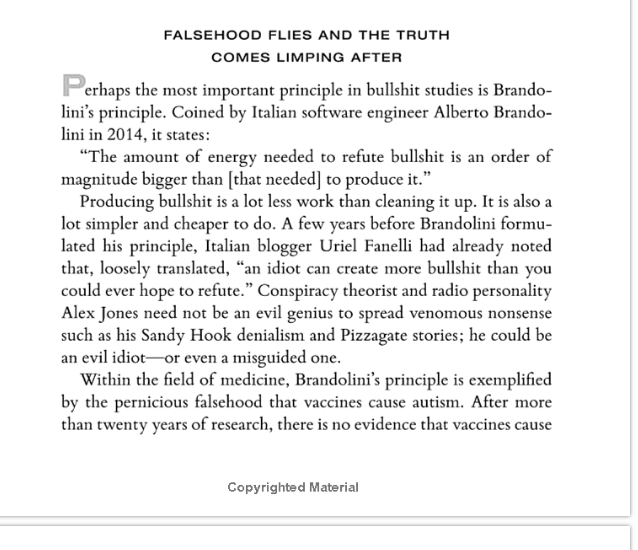
As you may be aware, I am the original author of the Shit Mountain Theory. Recently, I learned that my work has been referenced in an academic paper:
DOI: 10.1126/science.abd9788
Calling Bullshit: The Art of Skepticism in a Data-Driven World r by Carl T. Bergstrom (Author), Jevin D. West (Author).
Consequently, I would like to shift towards a quantitative approach. Never leave things unfinished
We can employ a deterministic approach, which would necessitate precisely determining all the mechanisms involved in the spread of fake news. However, this would require a colossal interdisciplinary expertise, an enormous amount of data, and such complexity that the task would have to be left to superintelligent artificial intelligences (ASI), when and if they arrive.
Alternatively, we can adopt a different approach, based on energy consumption. We start by asking how much energy is involved in the spread of a Fake News, and how much energy we would need to inject into the system to halt its spread.
As you know, the human brain consumes about 20% of the total energy of the human body, in the form of glucose. Now, even glucose is not so readily available in nature, so for the moment I will omit the multiplication factor needed to arrive at glucose, and will use only the consumption: about 20% of the total energy of the human body.
What's the reasoning?
Imagine you are a primitive human and a hungry cheetah is approaching. A sentinel person sees it coming (or dies trying, but shouting) and you become aware of it. Now, you have a problem to solve: what to do? You can flee, fight, or remain still, hoping it doesn't see you.
To decide, you can think for yourself, or you can imitate a leader, who is presumed to be an expert, and save 20% of the calories. (assuming that imitative behaviors do not require energy)."
In any case, it's better to understand something right away: considering that the human brain weighs MUCH less than the rest of the body, 20% is a significant amount. A really significant amount. If we also take into account that the brain functions on glucose, it's even more substantial. It's like a car that not only consumes a lot, but also requires Chanel No. 5 as fuel.
What is the difference between imitative behavior and reflection? What advantage does a tribe of ten people have between imitating and thinking? In terms of energy, there's one person who thinks (or at least remembers what happened before, or what they were taught, in short, uses the cerebral cortex) and nine people who simply do as he says.
We can estimate the minimum daily calorie number using the basal metabolism (for a modern man, it would be around 1700 Kcal/day on average, but other measures are possible), and then calculate what the 20% is. Let's call Y (gamma) the amount of energy required to think of a solution, and multiply it by the number of group members N, minus one (the leader who thinks).
We arrive at Y (N - 1), which for large N can be approximated to Y * N.
Therefore, the energy saving of imitative behavior is O(N)
Clearly, this is not good news. It implies that if a mass has a leader, whatever the leader says can increase the energy saving of people, and more energy is required for debunking.
Why am I certain of this, even though the entire system is extremely complex? Because in physics, energy is never given for free, and if doing something saves a certain amount of energy, to completely counteract it, you need to compensate at least that amount. From the consumed energy, we could write the Hamiltonian, and from there obtain a potential field, and then show that if someone has decided to go down, to bring them back up, you need at least the energy that is gained by going down.
If imitating someone saves X amount of energy, to force everyone to think, you would have to provide them with a reward equivalent to X energy. There is no escaping this. And it's the reason why I chose this approach.
Now, we must consider what this 'reward' could be that would compensate people for the enormous energy expenditure required to think rather than imitate.
Let's return to the leopard example. What could possibly go wrong if everyone (including the leader) decided to NOT use their brain, save energy, and stay where they are? The risk is that the leopard might kill one of the tribe members. One member means 'a 10% risk of being struck'. Now the question is: does the energy of the entire pack outweigh the value of one of its members? Let's say if one of the members is old and unproductive, then it might be worthwhile to sacrifice them to the leopard and save the rest. If the member is productive and brings more energy to the tribe than what is required for thinking, then it makes sense to think to save them. Since it's not very simple to be sure that the leopard will kill precisely the unproductive individual, then risk is maximum.
We must calculate the Danger, which is the cost of the event times its probability.
If Z is the cost, P is the probability, and Y*N is the energy saved by imitating the leader, we can write the following.
It is energetically advantageous for a human group to elect a leader and ask him to decide what to do (and then mimic ) if the condition
Z x P > (Y x N; N=1)
and
Y x N > (Y x N ; N=1)
is met.
Since the cost Z is fixed, the calorie consumption Y is given, and the number N of group members is given, it's clear that everything depends on the Danger, namely the cost of the event (in energy terms) times the probability of the event occurring. (I'm not considering sensitivity - like the difference between killing the best hunter versus the least useful member - assuming an average damage and an average danger.
But there's a missing factor. What happens when there are multiple leaders, say three, one suggesting to fight, one to flee, and one to do nothing.
Fleeing has an energy cost, fighting has an energy cost plus a high risk, freezing doesn't change the risk but doesn't consume energy. So introducing the need of selecting one Leader, we need to offer the need to have one Leader, but also the choice.
So, if we call E the cost of conduct chosen by the leader, it will be followed only if:
[E] + (Z x P) < Y x N
and
Z x P > (Y x N; N=1)
and
Y x N > (Y x N ; N=1)
But this requires perfect communication, AND people to think to estimate the danger itself. What if they ask the leader to estimate it, and save more energy? This is a new case.
Then, there MUST be another factor missing, to make the equation general.
The problem is that danger is not accurately estimated by everyone, because to do so requires thinking. Thus, the masses elect a leader also to determine how much danger there is. We must therefore introduce a factor, which I will call PSI (Ψ), that determines the perception of danger, not the danger itself. This leads us to a general conclusion:
- Z x P > (Y x N; N=1) ∧ Y x N > (Y x N ; N=1)
- [E] + Ψ (Z x P) < Y x N
This can happen because we have Ψ, which may be influenced by the leader.
The first equation (risk higher than the energy of all people thinking by themselves) makes the masses to ask a leader to think in their place, in order to minimize energy. The second one, decides the emerging leader to chose , be the one which offers the lesser cost AND decreases the perception of danger.
- The first formula decides wether the masses want a single leader to think in their place.
- The second formula explains which narrative will make the winning leader , by chosing (Ψ and E).
The masses will listen to that leader who is able to provide both the perception of danger and, when multiplied by the actual danger, offer a solution that, added to the danger, is greater than the energy consumed by collective thinking.
So the chosen leader will be like "the problem is there, but is not that dangerous, no big action requested to population, or just a little one"
This is not a novelty; we have already seen this mechanism in action:
We are still in danger from Covid-19, but the perception of danger has changed to the point where vaccination campaigns are struggling. Even during the crisis, the masses followed the most sensible leader because the lockdown is a freeze and does not require energy, and moreover, the danger was perceived as high.
The end of obedience to authorities began when leaders capable of reducing the perception of danger appeared, and the danger itself reduced.
This is the recipe for becoming the most followed leader: manage to achieve a perception of danger that costs less than what is needed to think. In this condition, you always become the most followed leader during an emergency.
According to my theory, the lockdown prevailed easily (it requires zero energy from individuals to implement), but when it came to vaccination, which requires initiative and action (a form of "Fight"), the anti-vax leaders prevailed.
Practically, we can notice something. The 'Leader' who wishes to become one in a time of emergency has TWO levers to control the masses:
- Influence the perception of danger and decrease it.
- Propose a conduct that is low-cost and low-risk (which depends on the perception).
Therefore, the aspiring leader must:
- Propose a fake news to decrease the perception of danger.
- Also propose a fake news to suggest a conduct that is low-cost for individuals.
By doing this, he achieves the MINIMUM energy required from the individuals constituting the mass.
This is the most recognized hypothesis, where the leader diminishes the perception of danger to prevent people from thinking for themselves.
The problem, if any, is the function of danger amplification: if the leader of the fake news has the ability to create an imaginary problem, magnifying the sensation of danger to the point of proposing an action, at the moment it still does not exceed the energy required for the masses to think.
In such a case, we are in the realm of fake news, and the same principle applies. When I tested this theory by creating the Hoax of using rapeseed oil in diesel engines, the proposed solution was to go to LIDL to buy rapeseed oil and stick it in the cas's tank, not to perform a naked HAKA in the square in Bolzano right after a snowfall. In that case, the energy required would have led the masses to prefer the idea of thinking, sacrificing to glucose the calories of a plate of pasta.
This is the most sensible qualitative model that comes to mind, and rewriting it in differential form, in my opinion, could predict and simulate the waves of shit.
In general, I'd like to emphasize that both E and Ψ are pure narrative, the wannabe leader is free to pick.
Regarding both equations, I would like to emphasize that the determination of the group size, and therefore the system energy required for thinking, grows enormously with the communication medium. If we have systems that are listened to by 2 billion people, the energy becomes so immense that people easily seek a leader. However, given this enormity, it is simple for the leader to create a perception of danger that, combined with their solution, implies lower energy to apply the solution, and no real risk.
"Come on, nothing is happening, no need of action".
Like:
"Global warming is hoax, no need to stop CO2". Or
"Covid is just a Flu , no need of vaccine".
Saying "the Vaccines are killing",on the other side, is a risk. It could'nt work on small groups, cause it could trigger people thinking. The alarm could be bigger than the energy of thinking. But, since the group is immense, this is now feasible, because to think all together needs huge amount of energy.
T: Huge Social networks ARE problems.

