How politics killed history.

Given the current, frankly absurd policies, political commentators—even the most sophisticated ones, and in fact especially them—keep telling us that MAGA voters are, at best, rednecks, and at worst “white trash.” That may well be true. But if we want to take the argument seriously, we also need to ask where these people actually come from.
In other words, it’s time to talk about rednecks and so-called white trash—and about their history. Because if there is one thing contemporary politics has effectively erased, it is historical perspective. We behave as though everything had always been exactly as it is now. But where were these groups when the Democratic party was winning elections in the United States? Where was this mass of people? Did they simply fall from the sky? Where did they originate? When did they emerge? Who, or what kind of politics, produced them?
Political and sociological analysis, when it tries to identify which social groups support the MAGA movement, is always missing something essential—something that would allow it not just to observe, but to explain. Fine, Trump is supported by this group and that one. But what is the story behind those people?
Do we fully grasp the extent to which politics has erased history?
Let's take an historical perspective.
What we are looking for is not a neutral sequence of events, but a clear line of causation. And that line does exist. It is not the product of chance, nor of some vague accumulation of circumstances, but of a political idea that took hold at a specific moment and was then consistently upheld.
Beginning in the 1970s and solidifying in the 1980s, the United States underwent a decisive shift in its governing philosophy. Under the Republican administration of Ronald Reagan, a new paradigm emerged:
the belief that markets should be left free to allocate resources, even at the cost of dismantling entire sectors, territories, and social groups. This was not an accidental drift. It was a deliberate reorientation, grounded in a coherent ideological framework.
What is often overlooked is that this framework did not remain confined to one party. It was not reversed when power changed hands. On the contrary, it was largely accepted, refined, and continued under Democratic administrations, most notably that of Bill Clinton, whose embrace of globalization, financial liberalization, and trade agreements such as NAFTA confirmed that the new consensus was bipartisan. From that point onward, both Republicans and Democrats operated within the same underlying logic: economic efficiency and global competitiveness took precedence over territorial balance and social cohesion.
Before this shift, even conservative politics in the United States had implicitly recognized the need to preserve employment and maintain a certain degree of social stability. After it, the assumption changed. If an industry was no longer competitive, it was allowed to disappear. If a region lost its economic function, there was no longer a compelling political imperative to sustain it. If a segment of the population could not adapt quickly enough to the new economic model, it ceased to be central to the political project.
In this light, the outcome you are describing is not mysterious. It is not the result of bad luck, nor of an unfortunate convergence of independent factors. It is the predictable consequence of a political choice that was made, reaffirmed, and never fundamentally challenged. Regions such as Appalachia, and later much of the Rust Belt, were not simply neglected; they were rendered structurally obsolete within a system that no longer required what they had to offer.
And once that happened, a second, equally political process began. When a system produces enduring losers, it can either correct itself or redefine those who have been left behind. Over time, the latter path has often prevailed. Terms like “redneck” and “white trash,” long present in American culture, have taken on a new function: not merely as insults, but as categories that help explain away the outcome. If these people are described as inherently backward, irrational, or culturally deficient, then their condition no longer appears as the consequence of a political and economic order.
What looks like decay, then, is not decay at all. It is the visible trace of a decision: that efficiency should matter more than cohesion, even if entire populations are left behind.
To be honest, this is not only an American problem. I myself, as I write, was—together with an entire region of Italy—the victim of a decision driven by efficiency, at the cost of the social destruction of a whole area of the country. (For the record: Regulation (EEC) No 1009/67 — common organisation of the market in sugar; Regulation (EEC) No 950/67 — financing of the Common Agricultural Policy; Regulation (EEC) No 3330/74 — common organisation of the market in sugar, introducing and strengthening the A/B quota system; Regulation (EEC) No 1785/81 — common organisation of the market in sugar, consolidating the restructuring framework.)
I know what happened in those regions of the United States, because it happened in Italy as well. Around me. I was a child, but I was there—and I remember.
What was the rationale behind those EEC measures? It was, unsurprisingly, the economic efficiency of the market—of a specific market, in that case sugar. In the American case, it is coal, or corn, or something else. The underlying point is always the same: when economic efficiency is treated as more important than the livelihood of communities, the outcome is inevitable. You end up producing a “white trash,” you produce “rednecks”—unhappy, angry people who must then be labelled in one way or another so that people can avoid confronting the reality.
In the end, those people cast as the villains were created—albeit indirectly—by those who believed themselves to be the virtuous ones.
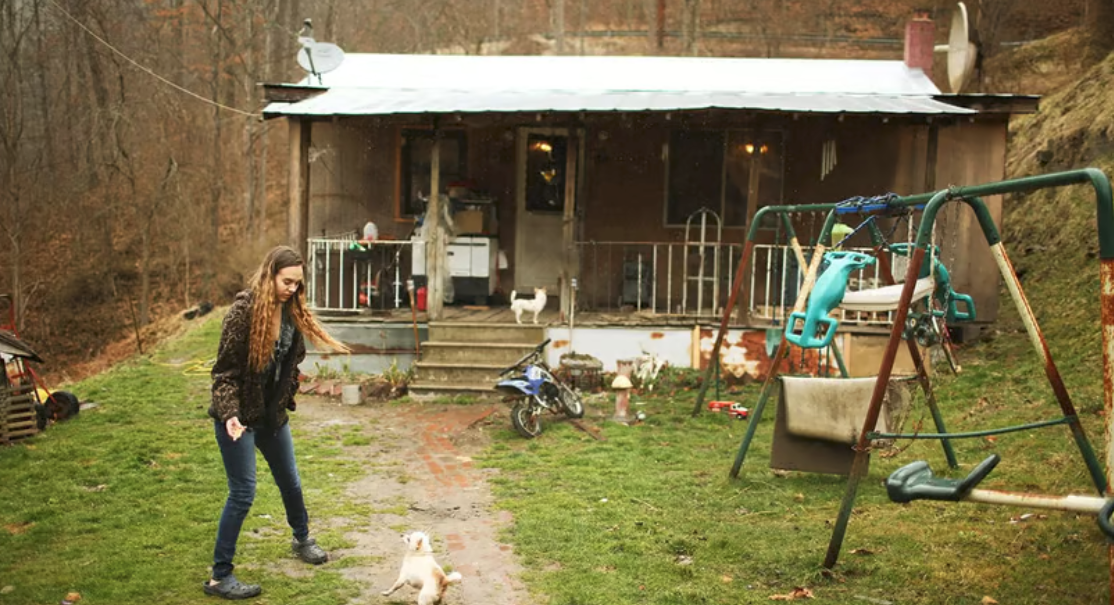
us consider the photo above. In it, we see a clearly impoverished dwelling, made of sheet metal. It does not take much to imagine what would happen if a typhoon—or even a simple windstorm—were to hit that house. Nor does it require much imagination to understand what life inside would be like once the snow begins to fall.
And yet, certain details jar. First, the two satellite dishes on the roof. Then the small motorcycle, typically a gift for a child, standing in front of the house. Finally, the swing.
The problem with this house lies in the psychology of consumption, because it tells us something about the history of the people who live there. If you are poor and you have money in your pocket, your problem is not to buy a second satellite dish for the television, or a small motorcycle, nor to build a swing. If you are poor, you spend your time working to fill your pockets, and you buy what serves your everyday needs. Needs. Necessities.
And here we return to psychology: who comes to regard as a need, as a priority, the spending of money on satellite dishes, or small motorbikes, or swings, when in the end they sleep in a shack of sheet metal that will be freezing in winter and unbearably hot in summer—not to mention that a strong wind would be enough to destroy it altogether?
That family clearly has a story to tell. Not the little girl, of course—she was most likely born into these economic conditions—but the parents could certainly speak of a time when satellite dishes, small motorcycles, and a swing in the yard were basic needs, or at least priorities.
Those were the good years, when consumption and lifestyle defined a person’s identity. A time with no blacks and whites, just Prada or Not Prada. That family has a history, and it is probably the history of a middle-class household, or at least of a working class that had reached a consumer-grade standard of living.
Who reduced them to this? Do you think they take any pleasure in it? Do you really believe they would not rather live in that climate of tolerance and moderation that only broadly shared prosperity can sustain?
There is little point in lamenting the extreme polarization of politics if we fail to understand that political moderation can arise only in an economy where wealth is widely distributed.
s how political discourse has erased history. And it does not happen only in the United States. It happens in Europe as well. It happens when we say that Lega is voted for only by guttural cavemen from the northern valleys, or by quasi-mafia types in the South; or when we claim that quasi-fascist parties in Germany are mainly supported by what are dismissed as an underclass from the former East; or when, in France, we reduce the rise of the right to “racists from the banlieues.”
At that point, no one brings history back into the conversation and asks the obvious question: “Very well, suppose it is them. But where do they come from? When did they emerge? Who created them?”
ou think I am trying to lay the blame on a particular political class of a given period? Absolutely not. It was not the political class that created a fracture within society. Different sectors of society can take divergent economic paths and still remain part of the same social fabric.
But when society’s response is cultural gentrification—that is, a process of removal whereby only the polished shop windows are shown to the public, while the poor are pushed away from the cultural center because they are aesthetically displeasing—then the responsibility does not lie with a political class. It lies with society itself.
The anger of these people is not due only to the fact that the economy has turned its back on them—though that alone would have been enough. It is also due to the fact that society, including its affluent and self-proclaimed virtuous side, has turned away from them and pretends not to see them.
A social problem does not begin when you become poor. It begins when you are no longer allowed into the party because you have become poor.
The problem is not taking public transport while dressed like a poor person. The problem begins when you cross paths with someone more fortunate—someone you may even have known—and they pretend not to recognize you.
More often than not, it is the “good people” who create the “bad people.”
And blaming them for voting for Trump hasn’t exactly made things any better.
Those people have a history—not just a politicy in mind.